
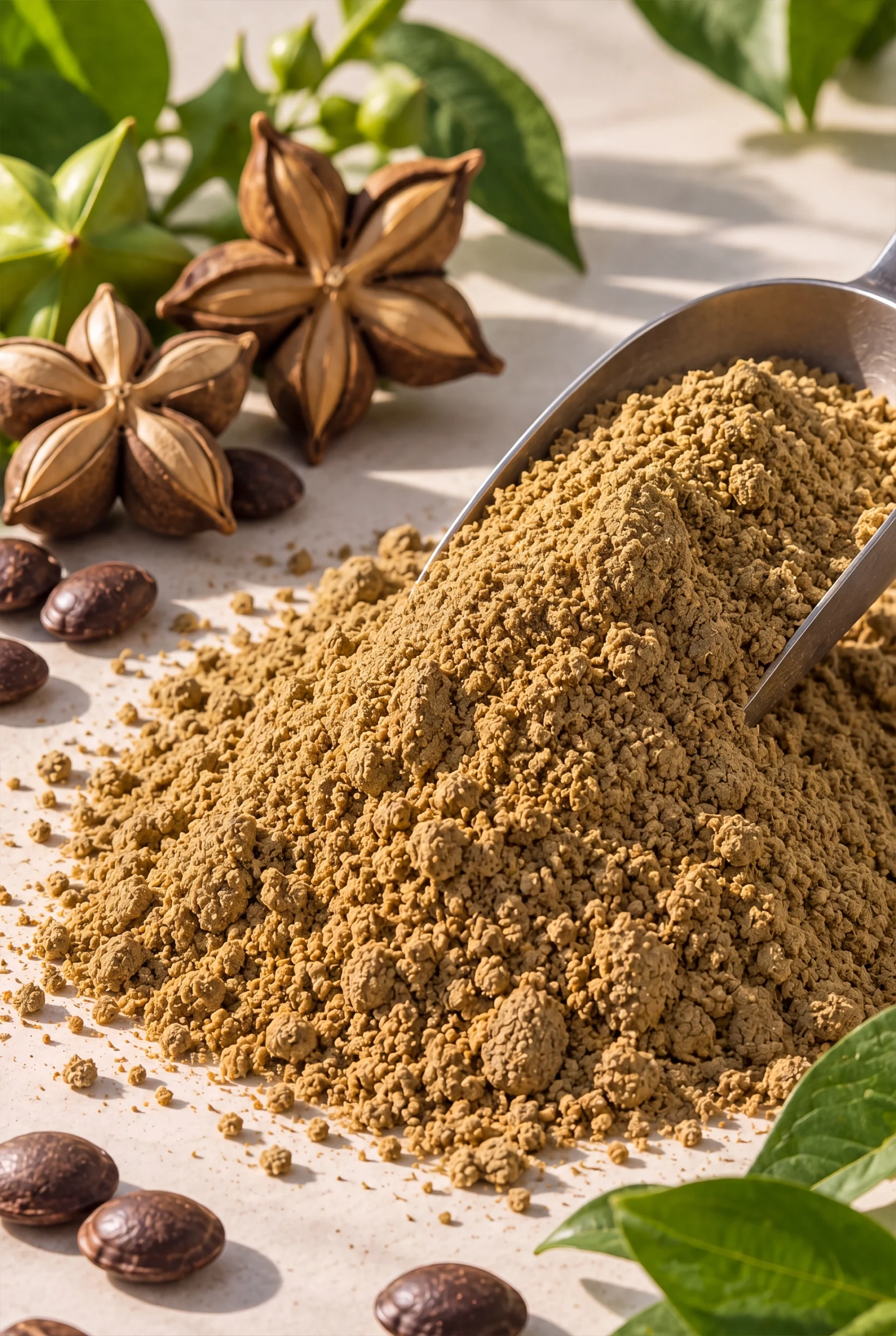
Mechanically pressed, thermally treated, milled and screened. 53–62% crude protein, complete essential amino acid profile, residual omega fraction retained. Supplied in 25 kg bags and 1,000 kg bulk bags.
Cold-pressed, unrefined, high-ALA lipid source for aquafeed and premium pet formulations. Natural tocopherol content intact for oxidative stability. Supplied in drums and IBC totes.
Batch-level compositional data, formulation consultation and trial-scale volumes for formulators evaluating the ingredient. Full certificate of analysis with every lot.
Where the science meets the feed
Every kilogram of Sacha Inchi we press yields two things: an oil, and a press cake containing over half its weight in complete protein. In most oilseed operations that cake becomes low-value filler. Here it becomes a functional feed ingredient — the same omega chain and the same amino acid profile that goes into human nutrition, formulated for animals.
Applications
The strongest structural case. Global aquaculture still depends on fishmeal and fish oil harvested from wild forage fisheries — a supply that is capped, volatile in price, and increasingly untenable as production scales. Every tonne of plant-based omega that displaces marine oil relieves pressure on a finite resource. Sacha Inchi meal and oil offer high ALA content and complete amino acids in a single ingredient. Freshwater and salmonid species convert ALA to longer-chain derivatives more efficiently than marine species, which makes them the logical first application. Inclusion rate must be established per species and life stage by trial.
The most proven pathway. Enriching eggs with omega-3 through hen diet is an established commercial practice, built largely on flaxseed. Sacha Inchi offers a comparable ALA payload with a better amino acid profile and a more stable lipid fraction, which matters in feed that sits in storage. The commercial logic is direct: the producer sells a differentiated egg at a premium, and the differentiation is measurable in a laboratory rather than asserted on a carton.
Coat condition, skin barrier integrity, joint comfort and cognitive support in ageing animals are the categories where omega supplementation is already established in premium pet nutrition. Sacha Inchi contributes ALA, complete protein and natural tocopherols in a single plant-derived ingredient, with no marine contaminant load and no fish odour — a genuine formulation advantage in a category where palatability and shelf stability are constant problems.
As a protein concentrate, the meal competes with soybean meal on amino acid profile — with adequate methionine, which is soybean meal’s specific weakness and the reason it is routinely supplemented synthetically. The residual omega fraction is additional value that soybean meal does not carry.
Coat, hoof and skin condition, and general condition support in performance and breeding animals. A smaller volume channel but a high-value one, with buyers accustomed to paying for functional ingredients.

Felines have very limited capacity to convert ALA into EPA and DHA. Plant-derived omega-3 is not a functional substitute for marine sources in feline diets, and Sacha Inchi does not supply taurine, which is an essential nutrient for cats. We will not market this ingredient as an omega-3 solution for cat food, and any supplier telling you otherwise is either uninformed or counting on you being uninformed.
Canine ALA to EPA conversion is limited, as it is in humans. Sacha Inchi is a legitimate contributor to dietary omega balance, coat condition and total protein quality in canine formulations. It is not equivalent to a direct EPA/DHA source, and we do not position it as one.
Unprocessed Sacha Inchi contains saponins, lectins and alkaloids at levels that impair digestibility and palatability, particularly in monogastrics. Our feed-grade material is thermally treated to inactivate these compounds, at a temperature calibrated to preserve lysine availability. Residual levels are verified analytically per batch. Anyone offering untreated meal at a lower price is offering a different and inferior product.
Optimal inclusion varies by species, life stage, production objective and the composition of the base ration. We provide full analytical data and technical support for formulation. We do not publish a universal inclusion rate, because one does not exist.
Protein meal
53–62% crude protein, thermally treated, milled and screened
Feed-grade oil
Cold-pressed, unrefined; 48% Omega-3 · 36% Omega-6 · 9% Omega-9
Amino acids
All nine essential amino acids, adequate methionine
Processing
Mechanical pressing below 40 °C, no hexane or solvents
Packaging
25 kg bags, 1,000 kg bulk bags, drums and IBC totes
Documentation
Full certificate of analysis with every lot
Origin
Amazon
For formulators
We provide batch-level compositional data, formulation consultation and trial-scale volumes for formulators evaluating the ingredient. Residual saponins, lectins and alkaloids are verified analytically per batch.
Contact us for the current specification sheet and to discuss inclusion trials for your species and production objective.
Yes. Our feed-grade material is thermally treated to inactivate saponins, lectins and alkaloids, at a temperature calibrated to preserve lysine availability. Residual levels are verified analytically per batch.
There is no universal rate — optimal inclusion varies by species, life stage, production objective and base ration. We provide full analytical data and technical support to establish it by trial.
Partially. Its high ALA content makes it a strong candidate in freshwater and salmonid species, which convert ALA to longer-chain derivatives efficiently. Inclusion must be established per species and life stage by trial.
Yes. We supply trial-scale volumes alongside batch-level compositional data and a full certificate of analysis with every lot.