
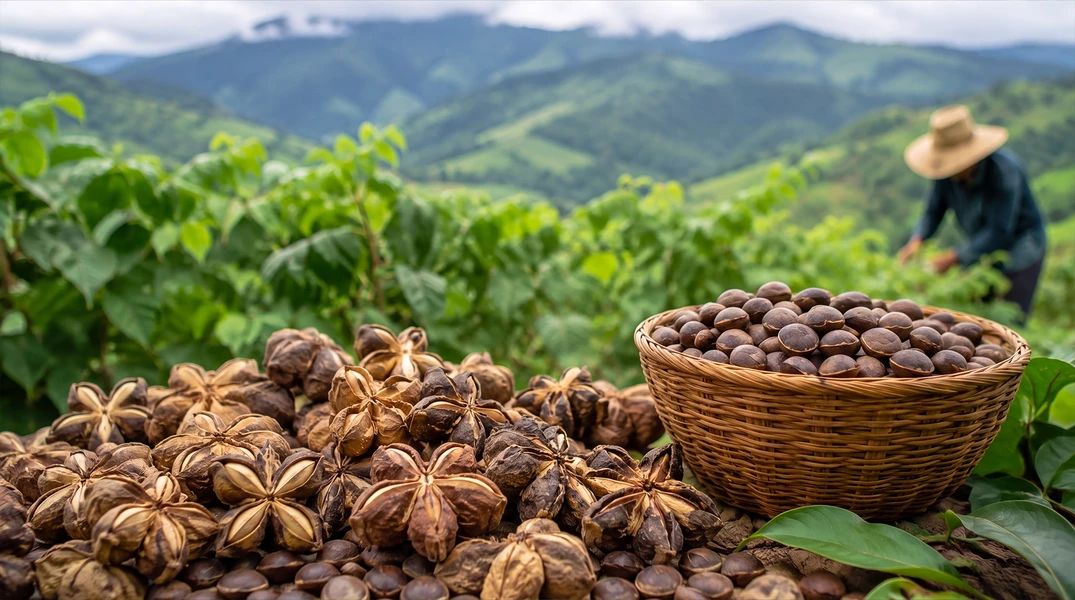
Inside the farming communities turning one seed into sustainable livelihoods
For most consumers, Sacha Inchi begins with a finished product.
A bottle of oil.
A protein ingredient.
A functional food.
A nutritional formulation.
But long before any of these products exist, Sacha Inchi begins somewhere very different:
on a farm.
Across tropical agricultural regions, small producers are discovering that Plukenetia volubilis L. can represent more than another crop.
When cultivation is connected to technical knowledge, reliable markets, local processing and long-term commercial relationships, one seed can become the starting point for an entire rural value ecosystem.
And that is where the real transformation begins.
More Than a Crop
Agriculture has traditionally asked farmers to do one thing exceptionally well:
produce.
Grow the crop.
Harvest it.
Sell it.
Repeat.
But this model often leaves producers at the beginning of a value chain in which most of the economic value is created later.
Processing.
Formulation.
Packaging.
Distribution.
Branding.
Export.
Retail.
The farther a product moves from the farm, the more valuable it frequently becomes.
Sacha Inchi offers an opportunity to rethink that relationship.
Because this is not simply a seed with one commercial destination.
It is a raw material capable of entering multiple value chains.
Its oil can become a premium nutritional ingredient.
Its seed can become a snack.
Its press cake can become flour or protein-rich ingredients.
Its components can move into food, nutrition, personal care and other emerging applications.
The same harvest can therefore participate in several different markets.
That changes the economic conversation.
Instead of asking only:
How much is the crop worth?
We can ask:
How much value can be created from everything the crop contains?
The Power of Diversification
For rural communities, dependence on a single crop or market creates vulnerability.
Weather changes.
Prices fluctuate.
Buyers disappear.
Input costs increase.
Demand shifts.
Diversification can make agricultural systems more resilient.
Sacha Inchi can become part of that diversification strategy.
Rather than requiring farmers to place their entire livelihood behind one agricultural commodity, it can operate as another productive asset within a broader farming system.
That distinction matters.
Sustainable rural development is rarely created by finding one miraculous crop.
It is created by building multiple sources of productive value.
Sacha Inchi can contribute to that model because its commercial potential extends beyond the raw seed itself.
More uses can create more buyers.
More buyers can create more market pathways.
More market pathways can reduce dependence on a single commercial outcome.
And a more diversified system can become a more resilient one.
From Farmer to Value-Chain Partner
One of the most important transformations in modern agriculture is conceptual.
The farmer is no longer simply the person who supplies raw material.
The farmer becomes the first quality controller in the entire supply chain.
What happens at the farm influences everything that comes afterward.
Seed selection.
Soil management.
Harvest timing.
Drying.
Moisture.
Storage.
Handling.
Traceability.
All of these decisions can influence the quality and commercial potential of the final ingredient.
That creates a new relationship between agriculture and industry.
The producer becomes part of the product.
And agricultural knowledge becomes part of product quality.
This is particularly important for ingredients destined for sophisticated international markets, where consistency and traceability increasingly matter as much as volume.
For Sacha Inchi, that means the strongest supply chains will not simply purchase seeds.
They will build systems capable of producing repeatable quality.
Knowledge Creates Value
Land is an agricultural asset.
But knowledge is one too.
When farming communities gain access to better agronomic practices, post-harvest management, quality standards and market information, something important happens.
They become capable of creating more value from the same biological resource.
Better cultivation can improve productivity.
Better harvesting can protect quality.
Better drying can reduce losses.
Better storage can preserve the seed.
Better traceability can open access to more demanding markets.
Better understanding of the final product can help producers understand why certain specifications matter.
This creates a powerful cycle:
knowledge improves quality
quality improves market access
market access creates incentives for better production
better production strengthens the supply chain
Agricultural development becomes less about producing more at any cost and more about producing intelligently.
Local Processing Changes the Equation
There is an enormous economic difference between exporting raw agricultural material and transforming it closer to where it was produced.
Processing creates additional layers of economic activity.
Equipment must be operated.
Facilities must be maintained.
Quality must be controlled.
Products must be stored.
Materials must be transported.
Workers must be trained.
Businesses must be created around these activities.
When part of that transformation happens near farming regions, agriculture can begin supporting something larger than farm income alone.
It can support rural industry.
Sacha Inchi is particularly interesting in this context because several components of the seed can potentially be utilized.
Oil.
Protein.
Flour.
Food ingredients.
Agricultural coproducts.
Future applications.
The objective increasingly becomes not simply to extract one valuable component and discard the rest.
It becomes:
How much useful value can we responsibly recover from every harvest?
That is the logic of a circular bioeconomy.
And it can fundamentally change the economics of agricultural production.
Turning Byproducts Into Opportunity
Traditional processing often divides agricultural materials into two categories:
the valuable product and everything left behind.
A more sophisticated model sees things differently.
It asks whether what was once considered a byproduct can become another ingredient.
Sacha Inchi creates interesting possibilities because the seed contains multiple fractions with potential applications.
The oil represents one value stream.
The remaining protein-rich material represents another.
Other agricultural residues may eventually support additional applications depending on processing technology, safety, economics and regulation.
This matters for rural economies because greater utilization of the harvested crop can increase the amount of value generated from the same hectare of production.
Instead of:
produce → extract → discard
the model moves toward:
produce → separate → transform → utilize
Every additional useful application can potentially strengthen the economics surrounding the crop.
The Importance of Stable Markets
Growing a crop is only half the equation.
Someone must want to buy it.
This is one of the most important realities in rural development.
Farmers cannot build sustainable livelihoods around theoretical demand.
They need real markets.
Predictable markets.
Markets capable of purchasing repeatedly.
That is why the future of Sacha Inchi depends as much on commercial development as agricultural development.
Consumers must understand the ingredient.
Brands must formulate with it.
Manufacturers must integrate it.
Regulators must recognize appropriate uses.
Supply chains must become reliable.
Quality must become standardized.
International markets must expand.
When demand grows responsibly, the agricultural system behind the ingredient has room to grow with it.
The relationship therefore works in both directions.
Rural communities make the ingredient possible.
And global demand can make its cultivation economically meaningful.
Traceability Reconnects the Consumer With the Farm
Modern food systems can make agriculture almost invisible.
Consumers see packaging.
They rarely see the farm.
They see an ingredient list.
They rarely see the people behind it.
Traceability can begin closing that distance.
A traceable Sacha Inchi supply chain can increasingly connect the finished ingredient with information about its origin.
Where it was grown.
How it was handled.
When it was harvested.
How it was processed.
How quality was verified.
This does more than create transparency.
It changes the relationship between origin and value.
The farm is no longer an anonymous point somewhere at the beginning of the supply chain.
It becomes part of the identity of the finished product.
For premium ingredients, provenance matters.
And when provenance can be documented rather than merely described, it becomes significantly more powerful.
Sustainability Is Also About Livelihoods
Agricultural sustainability is often discussed almost exclusively through environmental metrics.
Carbon.
Water.
Soil.
Biodiversity.
Those dimensions are essential.
But there is another dimension that cannot be separated from them:
economic sustainability.
A farming system cannot remain sustainable if the people operating it cannot build viable livelihoods.
Farmers must be able to invest in their land.
Support their households.
Absorb difficult seasons.
Improve productivity.
Adopt better technology.
And see a future in agriculture.
The strongest agricultural systems therefore need to balance three forms of sustainability:
Environmental sustainability
Protecting the productive capacity of the land.
Economic sustainability
Creating agricultural activity capable of remaining commercially viable.
Social sustainability
Building systems in which rural communities can participate meaningfully in the value created.
None of these dimensions can succeed for long without the others.
Creating Opportunity for the Next Generation
One of the greatest challenges facing rural regions around the world is generational continuity.
Young people frequently leave farming communities because traditional agriculture appears to offer limited economic mobility.
The future of rural agriculture therefore depends on creating systems that are not only productive, but also technologically and commercially relevant.
Modern Sacha Inchi supply chains can involve far more than farming.
Agronomy.
Laboratory testing.
Processing technology.
Logistics.
Traceability.
Export.
Food science.
Digital agriculture.
Quality management.
Entrepreneurship.
Brand development.
These activities create different forms of participation in the agricultural economy.
The farm remains the foundation.
But the ecosystem surrounding the farm becomes much larger.
That creates the possibility of transforming agriculture from a purely extractive occupation into a platform for rural entrepreneurship.
Small Farms. Global Markets.
Perhaps the most powerful aspect of modern ingredient markets is their ability to connect two worlds that were historically far apart.
A relatively small agricultural producer can become part of a supply chain that ultimately reaches consumers thousands of kilometers away.
That connection was once extraordinarily difficult.
Today, certification, traceability, logistics and digital information systems make it increasingly possible.
But access to global markets brings new expectations.
Consistency.
Documentation.
Food safety.
Quality.
Transparency.
Reliable supply.
This creates both an opportunity and a challenge.
The opportunity is access to markets capable of recognizing higher-value ingredients.
The challenge is building rural systems capable of meeting those standards repeatedly.
The future belongs to supply chains capable of doing both.
The Plukenia Vision
At Plukenia, we believe agricultural value should begin at origin — not only at the moment an ingredient reaches a factory.
The long-term opportunity surrounding Sacha Inchi is therefore much larger than producing another premium oil.
It is about connecting agriculture with science, processing, nutrition and global markets.
A strong value chain creates benefits in both directions.
Farmers gain access to knowledge and markets.
Manufacturers gain access to reliable ingredients.
Brands gain traceability.
Consumers gain transparency.
And the agricultural system becomes capable of generating increasingly sophisticated forms of value.
This is what we believe the next generation of ingredient companies should help build.
Not simply longer supply chains.
Better connected ones.
One Seed Can Create Many Futures
A Sacha Inchi seed is physically small.
Economically, its possibilities are much larger.
It can become food.
It can become oil.
It can become protein.
It can become an ingredient.
It can support processing.
It can create commercial activity.
It can connect rural producers with international markets.
And when those connections are built responsibly, agriculture becomes more than the production of raw materials.
It becomes the foundation of an ecosystem.
That is the real opportunity behind Sacha Inchi.
Not the idea that one crop can magically transform rural communities.
But something far more credible — and far more powerful:
one crop, connected to the right knowledge, infrastructure and markets, can help communities create more value from what they already know how to do best.
Grow.
Produce.
Adapt.
And build.
From one seed.
To sustainable livelihoods.