
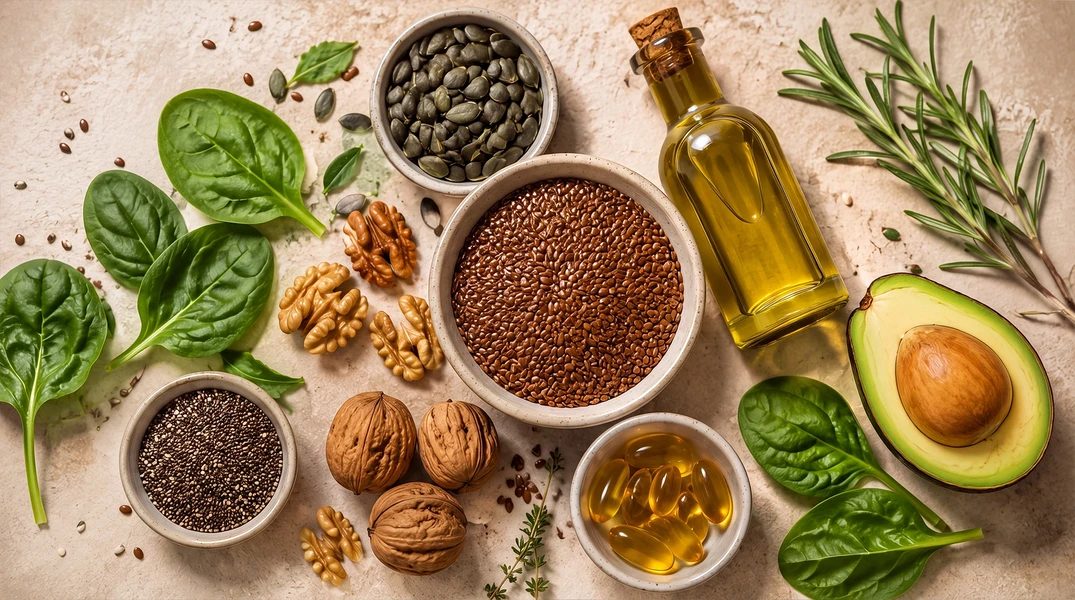
Optimizing Cognitive Performance with Plukenia Protocols: Dosing, Timing & Stacking Strategies
Cognitive performance is not built from a single molecule. It is built from biological infrastructure.
Sleep, glucose regulation, mitochondrial function, hydration, micronutrient status, stress physiology and the lipid composition of cell membranes all interact to determine how the brain performs.
Omega-3 fatty acids belong to that infrastructure.
But there is an important distinction that most discussions about omega-3 overlook: not all omega-3s are the same.
Plukenia — derived from Plukenetia volubilis L., commonly known as Sacha Inchi — is naturally rich in alpha-linolenic acid (ALA), the essential plant-based omega-3 fatty acid.
And “essential” has a precise biological meaning: the human body cannot synthesize ALA and therefore must obtain it through diet.
For biohackers, high-performance professionals and people pursuing a plant-forward lifestyle, the interesting question is not simply:
“Should I take omega-3?”
It is:
“How do I build an intelligent omega-3 strategy around the different roles of ALA, EPA and DHA?”
That is where the Plukenia Protocol begins.
01. Understand the Omega-3 System
There are three omega-3 fatty acids that matter most in human nutrition:
ALA — Alpha-Linolenic Acid
The essential plant-based omega-3.
EPA — Eicosapentaenoic Acid
A long-chain omega-3 involved in multiple physiological signaling pathways.
DHA — Docosahexaenoic Acid
A major structural fatty acid found in particularly high concentrations in the brain and retina.
ALA can be metabolically converted into EPA and subsequently DHA.
But there is a catch.
That conversion is limited.
The U.S. National Institutes of Health notes that conversion of ALA into EPA and DHA is relatively small, with total conversion reported below 15%, while conversion all the way to DHA may be substantially lower.
That means an evidence-based plant-based omega-3 strategy should not pretend that ALA and DHA are interchangeable.
They are not.
Instead, think of them as different components of the same nutritional architecture.
Plukenia provides the plant-based ALA foundation.
Preformed DHA and EPA — including versions produced from microalgae — can be considered separately when the objective is to build a fully plant-based long-chain omega-3 strategy.
02. Why Plukenia?
Sacha Inchi is unusual among plant oils because of its naturally high concentration of polyunsaturated fatty acids, particularly ALA.
Published analyses of Plukenetia volubilis oils have reported substantial concentrations of alpha-linolenic acid, although the exact percentage varies according to genetics, origin, agricultural conditions, extraction and processing.
That variability matters.
A serious biohacking protocol should therefore never be built around a generic internet percentage.
It should be built around the actual analytical profile of the oil being consumed.
The Plukenia Principle
Measure the molecule, not just the spoonful.
For every batch, what matters is:
grams of ALA per serving
—not simply—
milliliters of oil per serving.
For example, if a laboratory-verified Plukenia oil contained 48% ALA, every 5 grams of that oil would theoretically supply approximately:
2.4 grams of ALA.
That calculation should always be replaced by the actual specification and Certificate of Analysis of the finished Plukenia product.
Precision beats approximation.
03. The Baseline Plukenia Protocol
For healthy adults, current U.S. dietary reference values establish an Adequate Intake for ALA of:
1.6 g/day for adult men
1.1 g/day for adult women
These values represent nutritional adequacy — they are not cognitive-enhancement doses.
That distinction is critical.
There is currently no scientifically established dose of Sacha Inchi oil proven to acutely enhance cognition in healthy humans.
So rather than inventing one, the smarter protocol is to establish a measurable nutritional baseline.
FOUNDATION PROTOCOL
Objective: Consistent plant-based ALA intake.
Dose:
Use enough Plukenia to deliver at least the desired daily ALA intake according to the product’s verified fatty-acid profile.
Frequency:
Daily consistency is more important than occasional high dosing.
Administration:
Consume with a meal or as part of food rather than treating it like an acute stimulant.
Protocol duration:
Think in weeks and months — not minutes.
Plukenia should be approached as nutritional infrastructure rather than something expected to produce an immediate perceptible “kick.”
04. Timing: Does Morning vs. Night Matter?
This is where biohacking culture can easily move faster than science.
There is currently no convincing evidence demonstrating that taking Sacha Inchi oil at 7:00 a.m. rather than 7:00 p.m. meaningfully improves cognitive performance.
Consistency matters far more than clock time.
There is, however, an interesting pharmacokinetic observation.
In a human study examining 10 or 15 mL of Sacha Inchi oil, plasma ALA concentrations reached their maximum approximately two hours after consumption.
That does not mean cognitive performance peaks two hours later.
Those are two completely different claims.
A rise in plasma fatty-acid concentration is not evidence of an acute nootropic effect.
Therefore, the practical Plukenia timing rule is simple:
Choose the time that maximizes adherence.
Breakfast.
Lunch.
A post-training meal.
Your evening meal.
The best schedule is the one you can repeat.
05. The Plant-Based Cognitive Omega Stack
This is where the protocol becomes more sophisticated.
Because ALA conversion into DHA is limited, a plant-based biohacker does not necessarily need to choose between ALA and DHA.
The two can be approached as complementary components.
STACK 01 — FOUNDATION
Plukenia + Nutrient-Dense Meal
Use Plukenia as the ALA component of a meal containing whole foods, protein, vegetables and minimally processed carbohydrates.
The goal is not to create a pharmacological effect.
The goal is to build a consistent lipid and nutrient environment.
STACK 02 — THE COMPLETE PLANT-BASED OMEGA STRATEGY
Plukenia ALA + Algae-Derived DHA/EPA
For people who avoid marine animal sources, microalgae provide a direct plant-compatible source of long-chain omega-3s.
This solves an important biochemical limitation:
Plukenia supplies ALA.
Algal omega-3 supplies preformed DHA and/or EPA.
EFSA considers 250 mg/day of EPA + DHA an adequate intake for healthy adults from a general cardiovascular nutrition perspective. That figure should not be interpreted as a cognitive-performance dose.
Recent research evaluating omega-3 supplementation and cognition suggests potential effects across certain memory and visuospatial domains, but results vary substantially by dose, population, duration and omega-3 composition. The evidence is considerably stronger for some cognitive domains than others.
The implication:
Omega-3 biology matters. “More” is not automatically “better.”
STACK 03 — THE HIGH-PERFORMANCE MORNING
Plukenia + Breakfast + Your Existing Performance Routine
Plukenia can sit underneath a traditional performance stack rather than compete with it.
Coffee or tea may influence alertness acutely.
Food influences glucose availability.
Hydration affects concentration.
Sleep determines whether any of the above matter.
Plukenia plays a different role.
It is not designed to create stimulation.
It provides essential fatty-acid nutrition.
That is why it belongs in the foundation layer, not the stimulant layer, of a performance protocol.
06. What About Higher Doses?
This is where discipline becomes particularly important.
Human trials have investigated Sacha Inchi oil at a variety of intakes.
One randomized study administered 10 or 15 mL daily for four months and evaluated tolerability, safety markers and cardiovascular-related biomarkers. Liver and kidney biochemical markers remained unchanged during the study, although nausea was reported particularly during the early period of consumption.
Another randomized trial used 15 mL of Sacha Inchi oil in conjunction with a high-fat meal while examining metabolic responses.
These studies are useful.
But they do not establish that 10 or 15 mL is the ideal cognitive-performance dose.
This distinction matters enormously.
A biohacker should never take the highest amount used in a clinical study and automatically call it the “optimal dose.”
That is not optimization.
That is extrapolation.
07. Measure Before You Escalate
The most advanced protocol is not necessarily the protocol with the most supplements.
It is the protocol with the best feedback loop.
Before increasing intake, ask:
What am I actually trying to optimize?
Mental endurance?
Memory?
Focus?
Mood?
Recovery?
Cardiometabolic health?
General nutritional adequacy?
Those are not interchangeable outcomes.
Neither are the biomarkers used to evaluate them.
A rigorous personal protocol could track:
Subjective
- perceived concentration
- afternoon mental fatigue
- mood stability
- sleep quality
- gastrointestinal tolerance
Objective
- dietary omega-3 intake
- blood lipids when clinically appropriate
- omega-3 index or fatty-acid testing when available
- standardized cognitive-performance tests
- sleep duration and consistency
Change one variable at a time whenever possible.
Otherwise, if performance changes, you will never know why.
08. Storage Is Part of the Protocol
There is another variable sophisticated consumers should understand:
oxidation.
Highly unsaturated oils are chemically sensitive.
Light, oxygen, heat and prolonged storage can affect oil quality.
That means sourcing, extraction, packaging and storage are not secondary considerations.
They are part of the performance protocol.
A beautifully designed omega-3 strategy built around poorly handled oil is a contradiction.
Look for transparency around:
- fatty-acid composition
- oxidation parameters
- production date
- extraction process
- storage conditions
- batch traceability
- laboratory verification
Biohacking starts long before consumption.
It starts with ingredient integrity.
09. What the Science Does — and Does Not — Say
Omega-3 fatty acids play important physiological roles, and DHA is highly concentrated in brain tissue.
A recent systematic review and dose-response meta-analysis of randomized controlled trials found potential benefits of omega-3 supplementation across several cognitive domains, including primary memory and visuospatial function. But substantial heterogeneity existed between studies, and evidence quality varied considerably depending on the cognitive endpoint.
Here is the important part:
Those findings should not be converted into a claim that Sacha Inchi oil itself has been clinically proven to improve cognition.
Direct clinical evidence supporting Plukenia or Sacha Inchi as a cognitive-enhancing nootropic is not yet sufficient for that conclusion.
And that is exactly why the sophisticated position is stronger:
Plukenia is not being positioned as a miracle brain oil.
It is positioned as a precision plant-based source of essential omega-3 nutrition that can form part of a broader, intelligently designed performance system.
10. The Plukenia Protocol — Simplified
LEVEL 1 — FOUNDATION
Plukenia
Build consistent ALA intake using the verified ALA concentration of the product.
LEVEL 2 — COMPLETE OMEGA ARCHITECTURE
Plukenia + Algae-Derived DHA/EPA
Combine essential plant-based ALA with preformed long-chain omega-3s when appropriate.
LEVEL 3 — PERFORMANCE ENVIRONMENT
Omega Strategy + Sleep + Exercise + Metabolic Health + Nutrition
Because no fatty acid can compensate for chronically poor sleep, inactivity or an inadequate diet.
LEVEL 4 — PERSONALIZATION
Measure → Evaluate → Adjust
Use biomarkers and performance data when the level of optimization justifies it.
The Biohacker’s Rule
Biohacking is often described as finding shortcuts.
The better definition is finding leverage.
And biological leverage usually comes from correcting foundational constraints before adding complexity.
Plukenia fits that philosophy.
Not as a stimulant.
Not as a shortcut.
Not as a promise of instant genius.
But as something more fundamental:
a high-value plant source of an essential omega-3 fatty acid that the human body cannot manufacture on its own.
Build the foundation.
Measure what matters.
Stack intelligently.
Then optimize.
PLUKENIA SCIENCE NOTE
Plukenia is derived from Plukenetia volubilis L. and naturally contains alpha-linolenic acid (ALA), an essential omega-3 fatty acid. Fatty-acid concentration varies according to raw material, processing and finished-product specifications; product-specific nutritional information should therefore be based on validated laboratory analysis.
Information presented here is educational and is not intended to diagnose, treat, cure or prevent any disease. Individual nutritional requirements can vary. People taking medications, managing medical conditions, pregnant or breastfeeding, or considering high-dose supplementation should consult an appropriately qualified healthcare professional.