
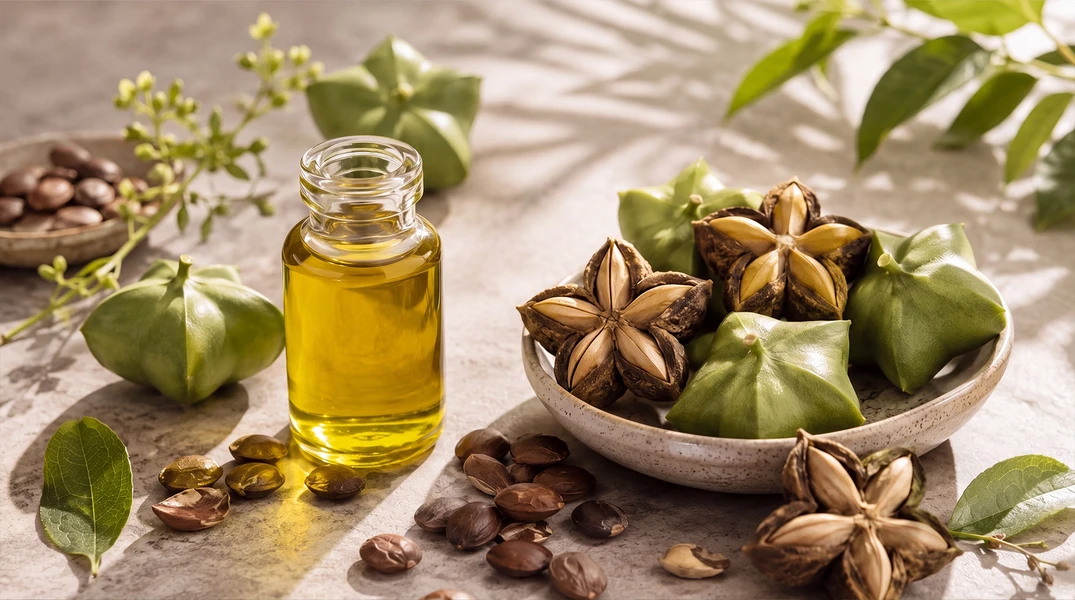
A science-based comparison of plant-based ALA and marine omega-3 across nutrition, sustainability, purity and performance
For decades, the omega-3 conversation has been dominated by one source:
fish oil.
The logic seemed simple.
Fish provide EPA and DHA.
EPA and DHA are biologically important.
Therefore, fish oil became synonymous with omega-3.
But omega-3 is not one molecule.
It is a family.
And a new generation of consumers is beginning to ask a more sophisticated question:
Is extracting omega-3 from marine ecosystems still the only — or even the most intelligent — way to build an omega-3 strategy?
Sacha Inchi offers a radically different model.
Derived from the seeds of Plukenetia volubilis L., Sacha Inchi oil is naturally rich in alpha-linolenic acid — ALA — the essential plant-based omega-3 fatty acid.
Research on different Sacha Inchi cultivars and extraction systems commonly reports approximately 44–52% ALA, with some Plukenetia materials reaching even higher concentrations.
That makes Sacha Inchi one of the world’s most concentrated natural plant sources of omega-3.
But comparing Sacha Inchi with fish oil requires understanding something fundamental:
ALA, EPA and DHA are not interchangeable molecules.
And that distinction is exactly where an intelligent comparison should begin.
First: There Is No Single “Omega-3”
Three omega-3 fatty acids dominate human nutrition:
ALA
Alpha-linolenic acid
An essential 18-carbon fatty acid found primarily in plant sources.
Humans cannot synthesize it.
It must come from food.
EPA
Eicosapentaenoic acid
A long-chain omega-3 involved in numerous physiological signaling pathways.
DHA
Docosahexaenoic acid
A long-chain structural omega-3 particularly concentrated in neural and retinal tissues.
Fish oil typically delivers EPA and DHA directly.
Sacha Inchi delivers predominantly ALA.
The human body can convert ALA into EPA and subsequently DHA, but that conversion is limited.
That fact matters.
It means the strongest case for Sacha Inchi is not:
“Plant ALA and fish-derived EPA/DHA are exactly the same.”
They are not.
The stronger proposition is:
“Do we need to obtain every component of our omega-3 strategy from fish?”
Increasingly, the answer can be no.
METRIC 01
Essential Omega-3 Nutrition
The Sacha Inchi Advantage
ALA holds a special biological status:
it is essential.
The human body cannot manufacture it.
It must be obtained through diet.
Sacha Inchi provides this essential fatty acid in unusually high concentration.
Research examining Plukenetia volubilis oils commonly identifies ALA as their dominant fatty acid, often representing roughly half of total fatty acids.
This creates an extraordinarily efficient plant-based delivery system.
A relatively small quantity of high-quality Sacha Inchi oil can provide meaningful amounts of dietary ALA.
By comparison, fish oil’s principal value lies elsewhere:
EPA and DHA.
So the comparison should not be framed as one molecule defeating another.
It is better understood as two different biological strategies.
Sacha Inchi → direct dietary ALA
Fish oil → direct EPA + DHA
That distinction matters enormously for intelligent nutritional formulation.
METRIC 02
Bioavailability
This is where scientific precision becomes essential.
After Sacha Inchi oil consumption, ALA clearly enters circulation.
A human pharmacokinetic study using 10 or 15 mL of Sacha Inchi oil found substantial increases in plasma ALA, with peak concentrations occurring approximately two hours after consumption.
So there is no meaningful question about whether Sacha Inchi can deliver ALA.
It can.
The limitation occurs afterward.
Humans convert only a relatively small proportion of ALA into EPA and DHA.
Therefore:
If your objective is increasing ALA:
Sacha Inchi is an exceptional direct source.
If your objective is increasing EPA or DHA rapidly and directly:
preformed EPA/DHA has the biochemical advantage.
Pretending otherwise would confuse absorption with conversion.
Plukenia takes a different position.
Use the right omega-3 molecule for the right biological objective.
That may mean Sacha Inchi as the plant-based ALA foundation.
And when direct DHA or EPA is desired, another source — including microalgae — can complement it.
This creates something fish oil cannot uniquely claim:
a completely non-fish omega-3 architecture.
METRIC 03
Sustainability
This may be where the future of the omega-3 industry changes most dramatically.
Fish oil ultimately depends on marine biological resources.
The environmental footprint varies considerably depending on species, fishery management, geography, whether the oil is derived from dedicated fisheries or processing byproducts, and how the resource is harvested and processed.
Responsible fisheries exist.
Marine byproduct utilization can also improve resource efficiency.
So simply declaring all fish oil environmentally unsustainable would be inaccurate.
But dependence on marine biomass creates a structural constraint:
the resource begins with an aquatic animal.
Sacha Inchi begins with a seed.
It can be cultivated.
Harvested.
Replanted.
Scaled agriculturally.
Integrated into rural economies.
And incorporated into regenerative and diversified agricultural systems when those systems are properly designed.
This changes the sustainability model from:
harvesting a biological resource
to:
cultivating a renewable agricultural resource.
That distinction becomes increasingly significant as global demand for omega-3 grows.
METRIC 04
Scalability
The world has a mathematical problem.
Billions of people.
Growing interest in omega-3 nutrition.
Finite marine ecosystems.
The future omega-3 economy is therefore unlikely to depend on a single biological source.
Fish will remain important.
Algae will grow.
Fermentation technologies may expand.
And high-ALA oilseed crops can occupy another part of the system.
Sacha Inchi belongs inside this diversified future.
Unlike marine extraction, agricultural production can potentially expand through:
- improved genetics
- better agronomy
- expanded cultivation
- increased productivity
- improved post-harvest systems
- regional processing
- utilization of coproducts
That creates a very different scalability pathway.
We are no longer asking:
How much omega-3 can we extract from an existing ecosystem?
We can ask:
How efficiently can we build a productive system to grow it?
METRIC 05
Purity
The purity debate is often oversimplified.
Fish can be exposed to environmental contaminants.
That does not mean every fish oil supplement contains dangerous levels of contaminants.
Modern purification technologies can produce extremely clean marine oils.
Properly manufactured products should be tested against specifications for contaminants such as heavy metals and persistent organic pollutants.
Sacha Inchi has a different starting point.
Because it is plant-derived, it avoids the category of contaminants associated specifically with marine food chains.
But plant origin does not automatically guarantee purity either.
Agricultural oils can still be affected by:
- pesticides
- environmental contaminants
- poor processing
- adulteration
- microbial problems in raw material
- inappropriate storage
- oxidation
The correct conclusion is therefore not:
Plant = pure. Fish = contaminated.
It is:
The risk architecture is different.
For Plukenia, purity should be demonstrated through testing rather than assumed from origin.
That means knowing the batch.
Knowing the farm.
Knowing the process.
And verifying the result.
METRIC 06
Oxidation
Omega-3 fatty acids have one inconvenient characteristic:
their molecular structure makes them susceptible to oxidation.
The greater the degree of unsaturation, the greater the challenge.
EPA contains five double bonds.
DHA contains six.
ALA contains three.
Marine omega-3 oils therefore require careful processing, antioxidant protection, packaging and storage.
Fish oil oxidation is sufficiently important that multiple studies have examined whether commercial products meet accepted oxidation specifications.
But Sacha Inchi is not immune.
Its extremely high ALA concentration also makes oxidative control essential.
This is why the quality of an omega-3 product cannot be judged simply by reading:
“contains omega-3.”
A serious specification should evaluate parameters such as:
- peroxide value
- anisidine value when applicable
- total oxidation status
- free fatty acids
- fatty-acid profile
- storage conditions
- exposure to oxygen
- temperature
- light
Sacha Inchi also naturally contains tocopherols, compounds that contribute to its antioxidant system.
But natural antioxidants do not eliminate the need for excellent processing and packaging.
The real advantage is not that one oil cannot oxidize.
Both can.
The advantage belongs to whoever controls quality better.
METRIC 07
Sensory Experience
Here plant-based omega-3 has an obvious consumer advantage.
Fish oil carries one sensory association that manufacturers have spent decades trying to eliminate:
fish.
Fishy aftertaste.
Fishy odor.
Fish burps.
Flavor instability.
Encapsulation has solved much of this for high-quality products.
But the underlying challenge remains intrinsic to marine lipid chemistry.
Sacha Inchi offers a fundamentally different sensory starting point.
A properly produced oil has a characteristic botanical and nutty profile rather than a marine one.
This opens possibilities fish oil struggles to access naturally:
culinary use.
Sacha Inchi does not have to exist exclusively inside a capsule.
It can become part of food itself.
Dressings.
Functional formulations.
Cold applications.
Nutritional products.
Daily rituals.
This difference may appear superficial.
It is not.
The nutritional intervention that people actually enjoy consuming is often the one they continue consuming.
METRIC 08
Plant-Based Compatibility
Here there is no ambiguity.
Fish oil comes from fish.
Sacha Inchi comes from plants.
That makes Sacha Inchi naturally compatible with consumers following:
- vegan diets
- vegetarian diets
- plant-forward nutrition
- marine-free supplementation strategies
- environmentally motivated food systems
The distinction becomes increasingly important as consumers begin evaluating not only what a nutrient does, but also where it came from.
For this audience, Sacha Inchi solves something fish oil fundamentally cannot:
the need for a plant-origin omega-3 ingredient.
METRIC 09
The Whole-Ingredient Opportunity
Fish oil is primarily valuable because of its lipid fraction.
Sacha Inchi is different.
The seed itself represents a broader biological platform.
Oil is one component.
After oil extraction, protein-rich press cake remains.
Research has reported protein levels exceeding 40% in Sacha Inchi press-cake materials, creating potential for additional food and feed applications when appropriately processed.
That creates several potential value streams from one agricultural crop:
Omega-rich oil
Protein-rich fractions
Flour
Food ingredients
Agricultural coproducts
Emerging functional applications
From a circular-bioeconomy perspective, this matters.
The objective becomes not simply:
extract the omega-3.
It becomes:
use as much of the biological resource as responsibly possible.
METRIC 10
Clinical Evidence
Here fish oil currently wins.
And pretending otherwise would undermine everything else Plukenia stands for.
EPA and DHA have been investigated in hundreds of randomized trials across cardiovascular health, triglycerides, inflammation, cognition, pregnancy and other areas.
The results are not universally positive.
Omega-3 research is complex.
Different formulations produce different outcomes.
Dose matters.
EPA and DHA may have different physiological effects.
Population matters.
Baseline omega-3 status matters.
But the depth of clinical investigation surrounding long-chain marine omega-3 is enormous.
Sacha Inchi research is much younger.
Human studies have demonstrated that its oil can increase circulating ALA and have investigated outcomes including lipids, blood pressure, tolerability and metabolic responses.
For example, a four-month randomized study using 10 or 15 mL of Sacha Inchi oil reported changes in several cardiovascular biomarkers and found no changes in the measured hepatic or renal safety markers.
Interesting?
Yes.
Definitive?
No.
The number, size and breadth of Sacha Inchi clinical trials remain far below those available for EPA and DHA.
This is not a weakness to conceal.
It is a research opportunity.
So Which Omega-3 Is Better?
That is actually the wrong question.
Because ALA, EPA and DHA perform different biological roles.
The future of omega-3 nutrition may not belong to one source replacing every other source.
It may belong to precision sourcing.
Need dietary ALA?
Sacha Inchi provides it directly.
Need EPA and DHA?
Use a direct source of EPA and DHA.
Want a completely plant-based system?
Combine high-ALA plant oils such as Sacha Inchi with algae-derived DHA/EPA when appropriate.
Want a renewable agricultural omega-3 ingredient with broader value-chain potential?
Sacha Inchi becomes particularly interesting.
This is no longer:
Plant versus fish.
It is:
Which biological source makes the most sense for each nutritional objective?
A New Omega-3 Architecture
For decades, omega-3 nutrition followed a simple equation:
Omega-3 = Fish Oil
That equation is becoming obsolete.
The emerging system looks more like this:
ALA
High-value plant sources such as Sacha Inchi
DHA / EPA
Fish, algae or other emerging technologies
Precision Nutrition
Matching the molecule to the biological objective
This is a more sophisticated system.
It is also a more scalable one.
Different sources perform different jobs.
And consumers no longer need to accept that omega-3 nutrition must automatically begin with fish.
The Plukenia Standard
Plukenia does not need to claim that Sacha Inchi is fish oil in botanical form.
It is something different.
And potentially more interesting.
A renewable agricultural source of essential ALA.
A seed capable of producing both oil and valuable coproducts.
A plant-based ingredient compatible with the future of food.
An opportunity to connect sophisticated nutrition with agricultural value creation.
And a platform whose scientific potential is still being explored.
The next generation of omega-3 will not be defined simply by how many milligrams appear on a label.
It will be defined by better questions:
Which omega-3?
From where?
How was it produced?
How pure is it?
How fresh is it?
What does the science actually demonstrate?
And what biological objective are we trying to achieve?
That is the standard Plukenia believes consumers deserve.
Not more omega-3 marketing.
Better omega-3 intelligence.
PLUKENIA SCIENCE NOTE
Plukenetia volubilis L. oil is naturally rich in alpha-linolenic acid (ALA), an essential omega-3 fatty acid. ALA can be converted by the human body into EPA and DHA, although conversion is limited. Sacha Inchi oil should therefore not be considered nutritionally identical to direct sources of EPA or DHA.
Fatty-acid composition varies by cultivar, growing conditions and processing. Product-specific claims should be based on validated laboratory analysis of the finished Plukenia product.
Information presented here is intended for educational purposes and should not be interpreted as medical advice or as claiming that Sacha Inchi prevents, treats or cures disease.